Greetings! 👋
Summer’s here, and June gave Ethereum plenty to unpack. The Ethereum Foundation reorganized around a leaner, “multi-node” future, prediction markets went mainstream on World Cup fever, and onchain credit landed one of DeFi’s largest raises ever. Let’s dig in.
Subscribe now
⚡ Highlights
1. The EF Reorg, and Ethereum Development’s Multi-Node Future
On June 23, the Ethereum Foundation confirmed the end of a months-long reorganization: 54 people cut, roughly 20% of staff, with Vitalik noting an ~40% budget reduction. It closes an arc that ran from Tomasz Stańczak’s exit as co-ED in February through Hsiao-Wei Wang stepping down on June 18, with Bastian Aue now the key interim executive lead.
The EF is now organized around five clusters: protocol, access, user, community, and institutional, with operations and management alongside, mapped to the layers of the stack. It’s March’s Mandate made concrete: the EF describing itself as “one of many nodes” and a “technological protocol steward,” narrowing its scope under a stated principle of subtraction.
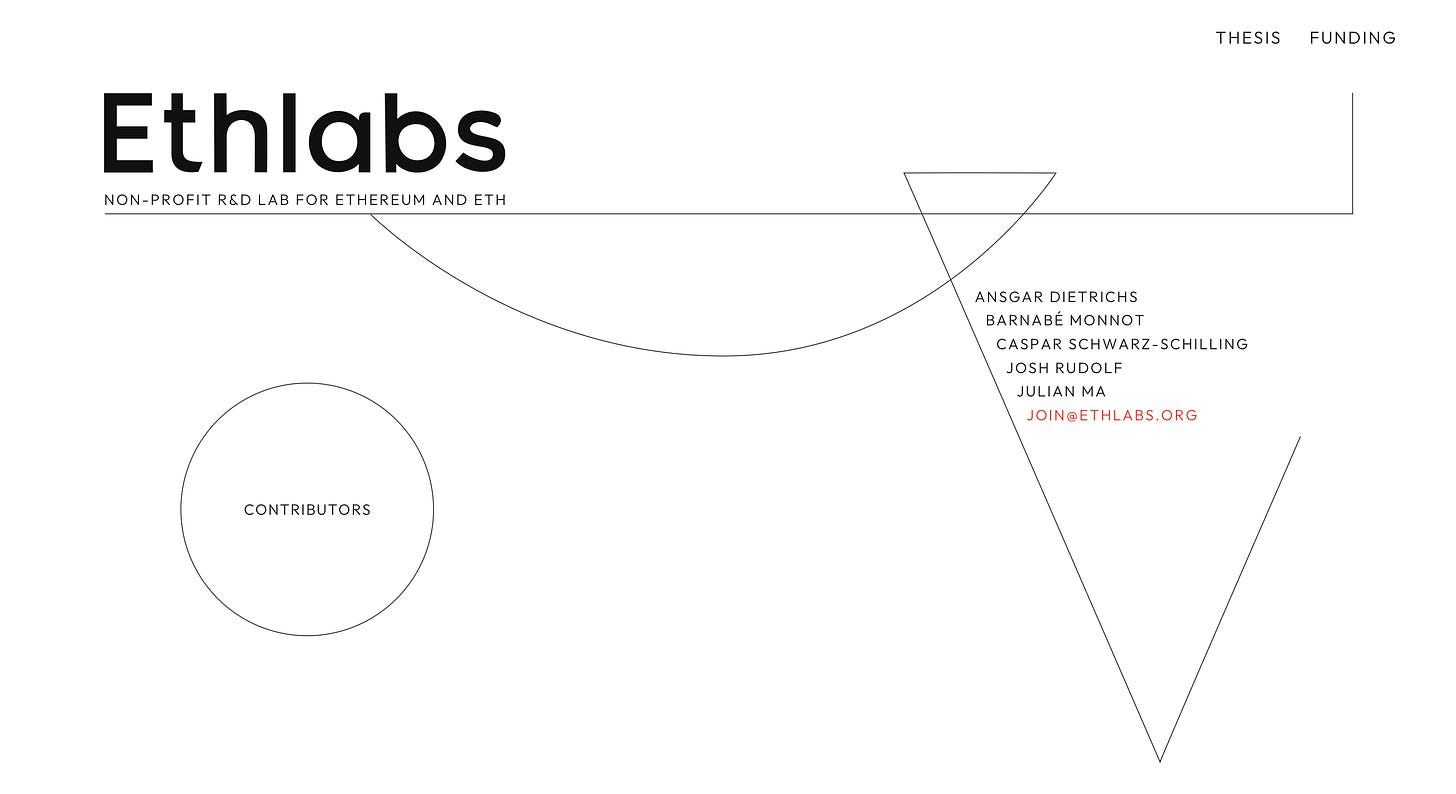
The growth work moved outward rather than away. Five former senior EF researchers: Ansgar Dietrichs (ED), Barnabé Monnot, Caspar Schwarz-Schilling, Josh Rudolf, and Julian Ma, launched EthLabs, an independent non-profit R&D lab whose anchor funders are BitMine, SharpLink, and Joe Lubin, with SNZ, Octant, Anchorage Digital, and Konstantin Lomashuk as contributors and a broad community of individual backers from across the ecosystem. Its stated mission: make Ethereum “the settlement layer of the global economy.” Alongside EthLabs, a wider set of ETH-aligned orgs has stepped up to carry work the EF pulled back from: the Argot Collective, Etherealize, the Economic Zone, and the Applications Guild.
Why it matters: the EF has limited resources, so a leaner, more focused foundation is a healthy thing. It can concentrate on the protocol’s hardest-to-replicate properties while a growing set of ETH-aligned organizations drives adoption and growth. That points to a more mature, more decentralized ecosystem. The multi-node model asks more of coordination than a single steward did, and for now the tone across these orgs is collaborative.
https://ethlabs.orgFurther reading:
2. Polymarket and the World Cup
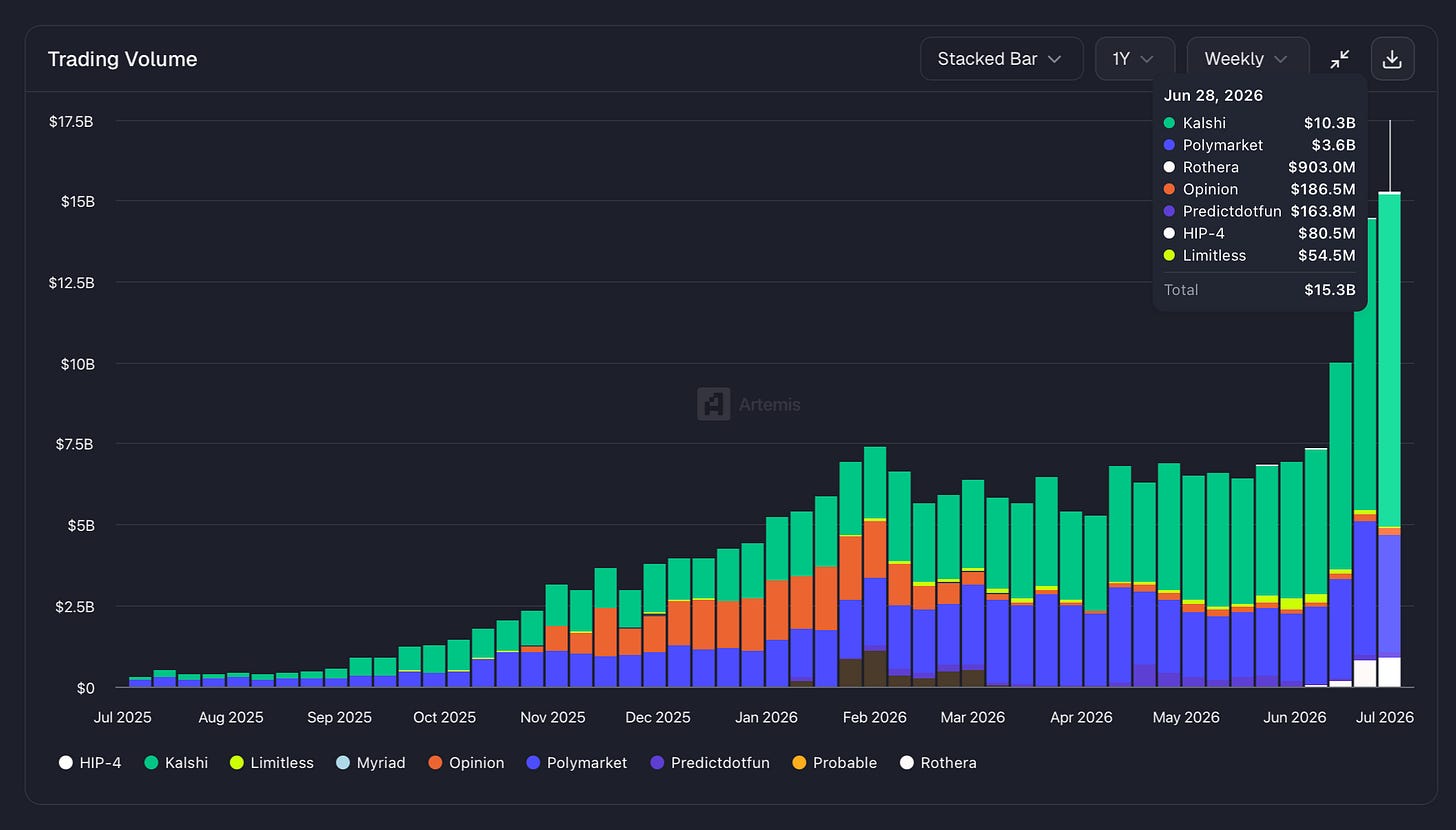
Prediction markets had a landmark June. Weekly volume peaked near $15B in late June, roughly thirty times the same week a year ago.
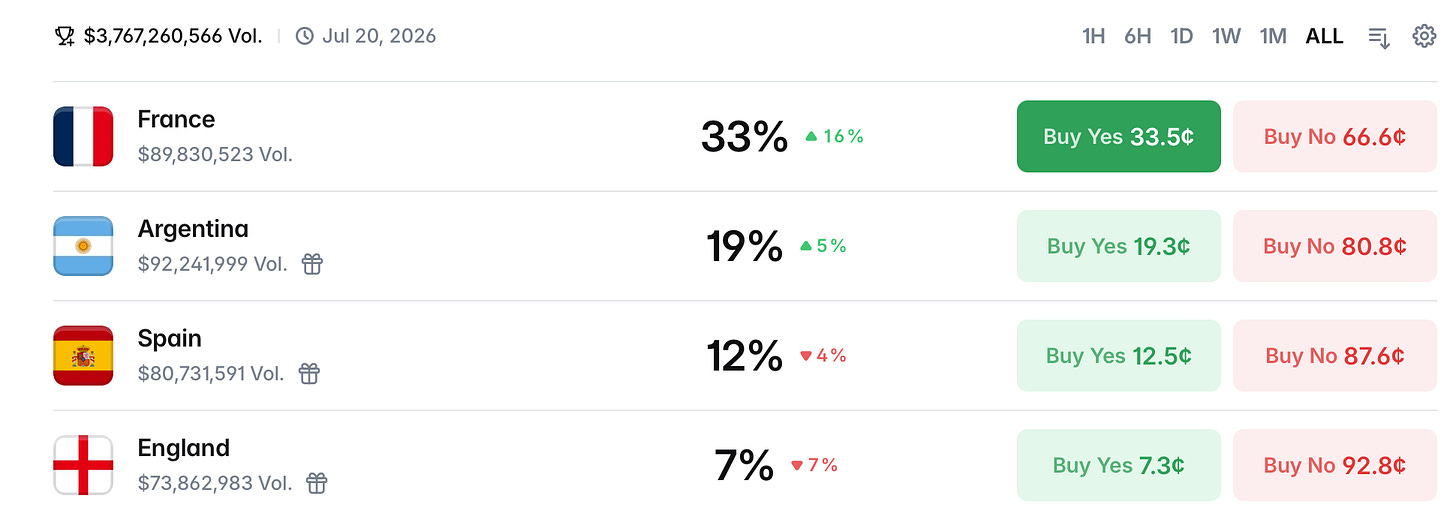
Polymarket’s World Cup winner market has traded roughly $3.8B, its biggest market ever, and one of the largest single contracts any prediction market has run. The scale has turned single bets into spectacle: on-chain, anyone can watch the biggest wallets move in real time. Polymarket started as a crypto product; this looks more like consumer infrastructure.
Reports say Meta is building a standalone prediction-market app, Arena, modeled on Polymarket and Kalshi but launching with points instead of real money to sidestep the regulatory thicket. It can funnel users straight from Facebook and Instagram, a distribution advantage no rival can match. The bigger prize is owning prediction markets as a consumer format, a real-time social feed for hundreds of millions to weigh in on sports, politics, and news.
Why it matters: the World Cup is the clearest proof yet that prediction markets have gone mainstream. The tournament pulled hundreds of millions in real-money interest onto a single event. And because Polymarket settles on-chain, that consumer moment flows through ETH-aligned infrastructure. Transparent settlement, public wallets, and real-time position tracking create an experience that traditional sportsbooks can’t replicate.
Source: polymarket.com/event/world-cup-winner