Monthly RoundupWhat is Quadratic Funding?
Local Ethereum·September 29, 2026·6 min read Greetings! 👋
Quadratic funding splits a matching pool by how many people back a project, not how much they give. It's Ethereum's most widely used community allocation tool, and its weak points are well documented by now. This issue covers how it works, where it breaks, and when to use it. Let's dig in.
TL;DR
Quadratic funding (QF) splits a shared matching pool according to how many people back a project. How much each person gives matters much less.
It is the most widely used community allocation tool in Ethereum, and it has funded early work behind EIP-1559, Optimism and privacy tools like Tornado Cash.
Its core weakness is identity. The formula rewards headcount, so fake accounts and coordinated groups are the main attack.
1. The problem QF tries to solve
Public goods (open-source libraries, research, education) suffer from the free-rider problem: anyone can use them without paying, so most people don’t, and leave the cost to others. Public goods stay chronically underfunded.
Quadratic funding (QF) is a more democratic way to fund public goods. It weakens the influence of any single large donor and amplifies donations by how many people back a project. With a fixed matching pool, the crowd decides how the pool is split, instead of a committee or token whales.
It was proposed in 2018 by Vitalik Buterin, Zoë Hitzig and Glen Weyl in “A Flexible Design for Funding Public Goods.”
2. How QF works
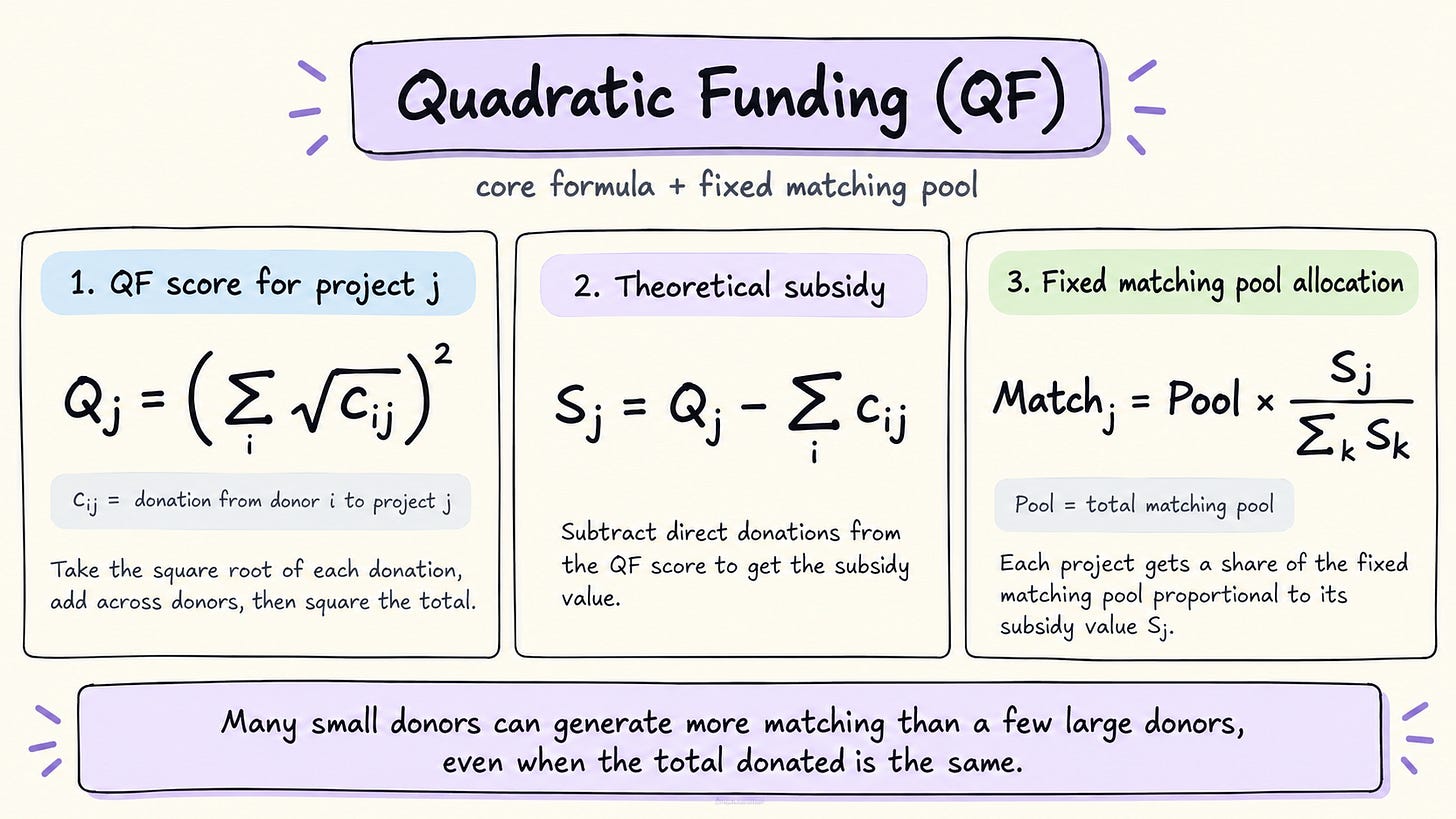
For each project, QF takes the square root of every donation, adds them up, and squares the total. That’s what the project should get in total. Subtract what donors already gave, and the rest is its claim on the matching pool.
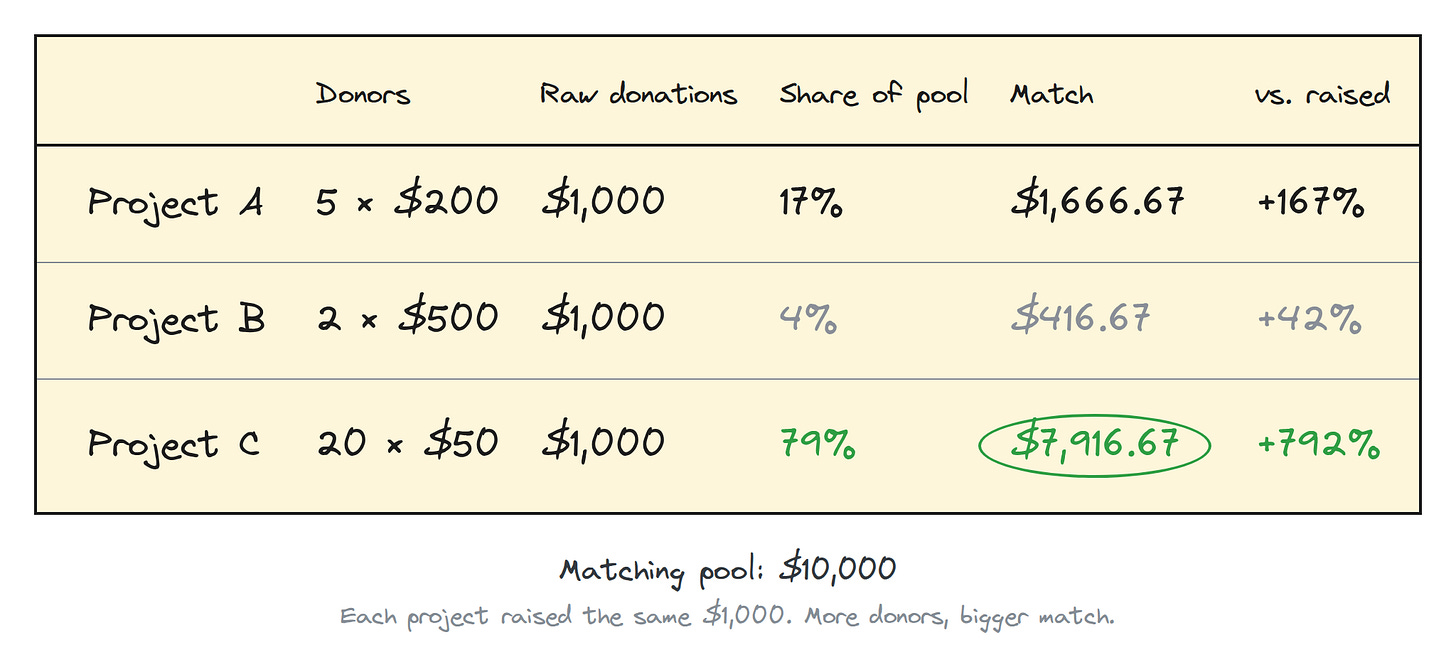
Here’s an example:
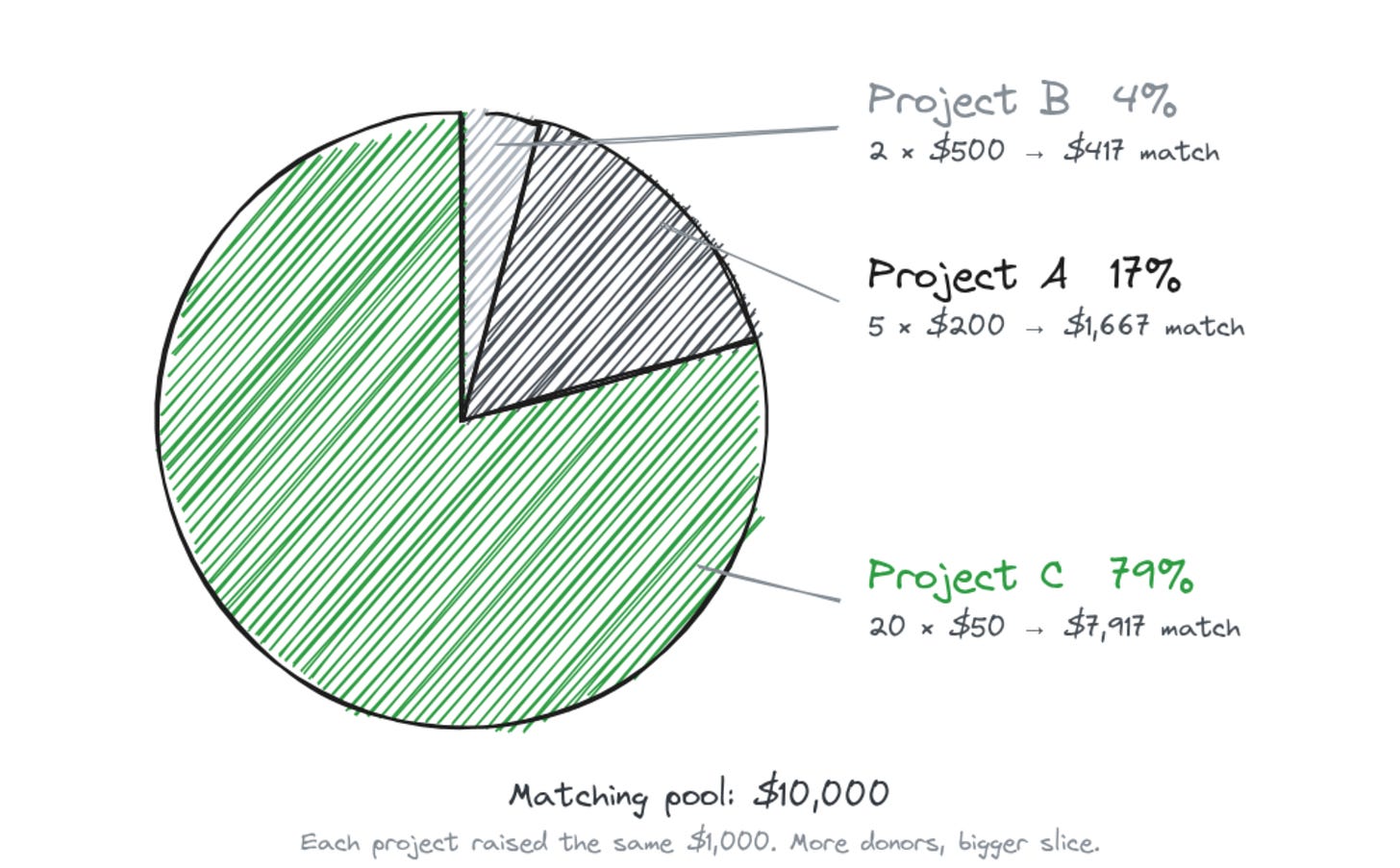
All three projects raised the same $1,000. The only difference is how many people gave. Project C’s 20 donors earn it $7,917, about 79% of the pool and nearly 8× what it raised. Project B’s 2 donors earn it just $417, 19× less.
The square root shrinks large donations more than small ones, so many small donors outweigh a few big ones. That’s deliberate: more donors means more people benefit. In theory, with an unlimited pool and no fake or colluding accounts, QF funds each project as much as its community would agree to if everyone could coordinate.
3. Track record
Gitcoin Grants is the reference deployment. It is the largest and longest-running QF program, having distributed over $60 million to more than 3,700 projects since 2019. Early rounds helped fund core Ethereum R&D, including EIP-1559 implementation, early research by Plasma Group (the team that became Optimism), and privacy protocol Tornado Cash before the OFAC sanctions.
QF also funds community work: at ETH Latam 2022, over 60 attendees used a QF round to direct more than 30,000 DAI to public goods projects across Latam.
The idea has also travelled beyond crypto-native funders: in 2022, UNICEF’s Office of Innovation ran a QF pilot with Gitcoin for 10 impact-focused, innovative projects from around the world, reaching 15k+ donors. In 2024, Manifund ran a $200k QF round for the effective altruism community, where 340 participants funded 50+ community projects.
4. The weak spots
QF rewards the number of people who give. Anything that inflates that number inflates the match.
Sybil attacks. One person splits a donation across many fake accounts, so the project looks like it has broad support. The typical pattern: dozens of newly created wallets, each giving a small, similar amount, all to the same single project.
Collusion. Verified, real donors coordinate to inflate a project’s apparent support: projects trade donations (”I fund yours, you fund mine”), or pay donors to contribute in exchange for a share of the match.
5. How QF defends against attacks
Identity scoring raises the cost of fake accounts. Gitcoin Passport scores donors on stamps and onchain history. In GG24, QF donors needed a model score above 50 or more than 15 stamps.
Cluster matching (COCM) cuts the payoff of coordination. It gives less match weight to donors with similar giving patterns.
MACI makes collusion unenforceable. clr.fund encrypts contributions, so no one can prove how they voted and vote-buying can’t be verified.
6. The practical limits
The defenses above target attackers. Some limits remain even when everyone plays fair. QF needs another three things: enough donors, donations that reflect real benefit, and a funded matching pool.
Fewer donors. Individual donations decide where the pool goes. In Gitcoin’s GG24 round (October 2025), donors fell 87%, from 9,991 in GG23 (giving $95,278) to 1,286 (giving $36,657). Three likely causes:
More friction. The Passport check and the overall UX deter donors, especially small ones. Sybil resistance costs participation.
Bad timing. The round opened four days after a $19 billion liquidation day, the largest in crypto history.
Fewer airdrop hopes. With fewer token launches, fewer people donate hoping for a future reward. Past volumes may have partly reflected airdrop hopes.
Popularity bias. With hundreds of projects in a round, donors reasonably rely on shortcuts: projects they know, recommendations from people they trust, what others are already backing, and sometimes the chance of a future airdrop. Funding tracks visibility as much as usefulness. Well-known infrastructure like Protocol Guild does fine; developer tools and programming languages lose, since the millions who benefit through apps never see them, and they rarely launch tokens.
A shrinking matching pool. Funding the pool is itself a public goods problem: each sponsor bears the full cost, but the benefits go to everyone. Outside the Ethereum Foundation, many large funders have shifted toward projects that grow their own ecosystems, where they capture more of the return.
7. Our take
QF optimizes for how money is split, not how much is raised. It works best where value is easy to see and benefits many people directly: early projects with grassroots support, regional builder groups, meetups and education. There, donations tend to reflect real benefit, and small donors get a real say.
It fits poorly when the priority is raising the most money, or for long-term infrastructure, where visibility is low and needs span years; expert review, metrics-based retro funding or direct grants work better there.
Running QF is relatively cheap on existing infrastructure like Gitcoin’s. Building it from scratch means setting up sybil resistance, round operations and donor onboarding, which takes significant money and time. Either way, someone still has to fund the matching pool, and the design should keep giving simple: donors just want to donate, and every extra step loses some of them.
What to watch:
Whether yield-based matching pools (e.g. the Gitcoin × Octant idea) give QF a sustainable funding source
Whether identity layers get better without adding friction that drives away real donors
How funders combine QF with retro and expert-led rounds in one program
Further Reading:
To end, a line from Friedrich Hayek (1945): "…we must show how a solution is produced by the interactions of people each of whom possesses only partial knowledge."
Take care! ❤️
Riely and the Geode Labs
Have thoughts on this issue? Reply or DM me - I read everything.
Want to support Local Ethereum? Reach out about sponsorships.
Local Ethereum
Writer at Local Ethereum, covering Ethereum adoption from a local, ground-up perspective.
Published September 29, 2026 · 6 min read
Local Ethereum
Enjoying the read? Get this in your inbox.
In-depth Ethereum ecosystem coverage: regional deep dives, monthly roundups, and global analysis. Twice a month, free.
Subscribe, it's free