Regional Deep Dive Riely·December 5, 2025·11 min read
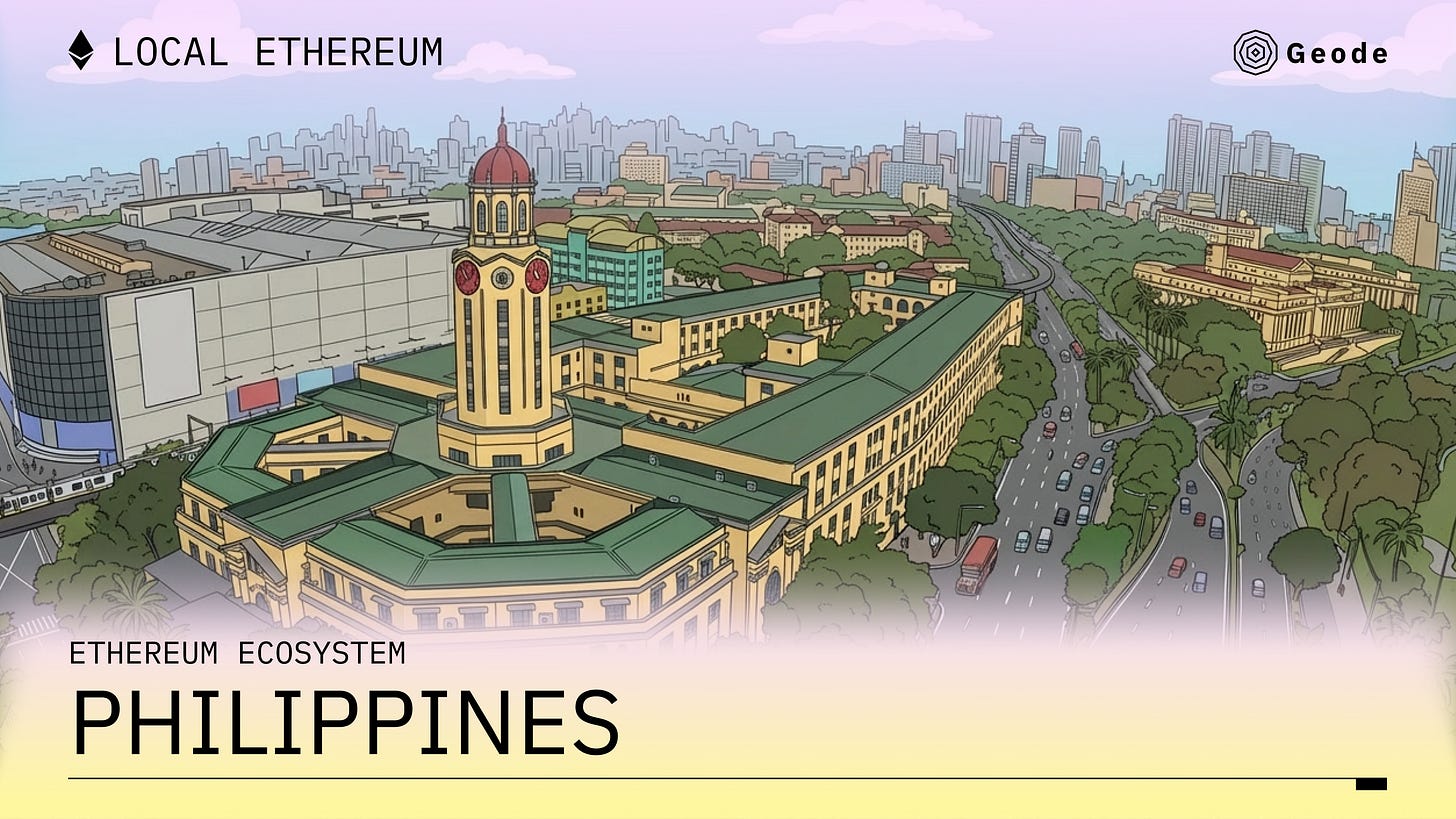
The Philippines Ethereum Ecosystem Overview
Special thanks to Michael Mislos, Ruben Lacumba Jr., Christine Erispe, Luis Buenaventura, and the ETHPH community for their insights and contributions.
TL;DR
Adoption Powerhouse: The Philippines remains in the global top 10 for crypto adoption, with an estimated 12+ million Filipino users in 2025. Adoption is driven not only by speculation but by real needs: remittances, income generation, digital payments, and financial access.
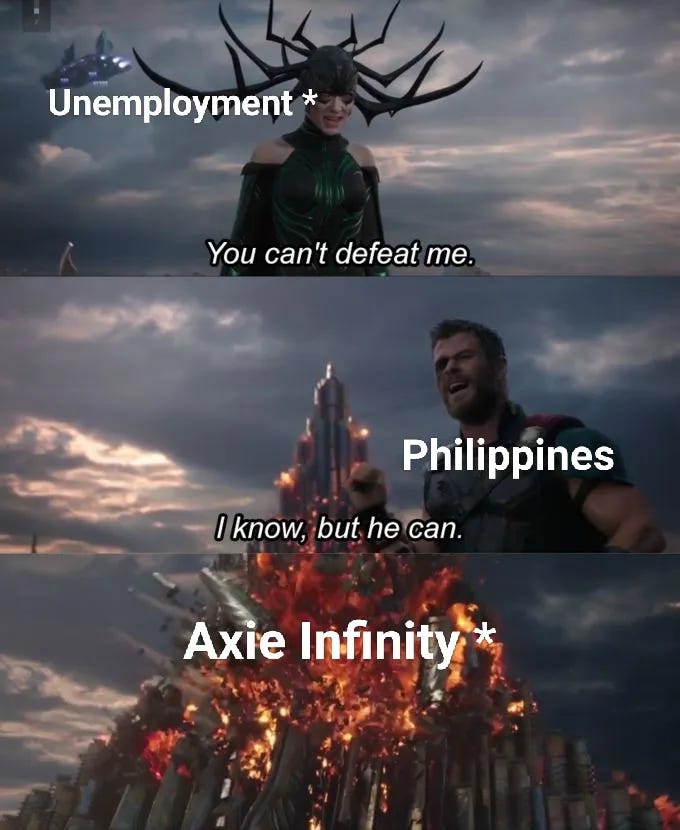
The “Axie Effect”: Play-to-Earn gaming became the country’s first mass-scale Web3 on-ramp. Although the hype has cooled from its peak in 2021, it established widespread crypto literacy and wallet usage across millions.
Regulatory Friction: With the BSP’s VASP moratorium and the SEC’s CASP rules, uncertainty persists. Yet real-world blockchain pilots, from tokenized bonds to digital credentials and public finance tools, show the country’s increasing capacity for innovation.
Ethereum Opportunity: While retail users are heavily into crypto trading and Web3 games, there are massive untapped opportunities to Ethereum-based DeFi, real-world assets (RWA), and stablecoin infrastructure, especially for the still 49.8% unbanked population.
1. Adoption Metrics: A Regional Leader
Global Rankings
Chainalysis 2025 Global Crypto Adoption Index: 9th globally (down from 8th in 2024 and a peak of 2nd in 2022).
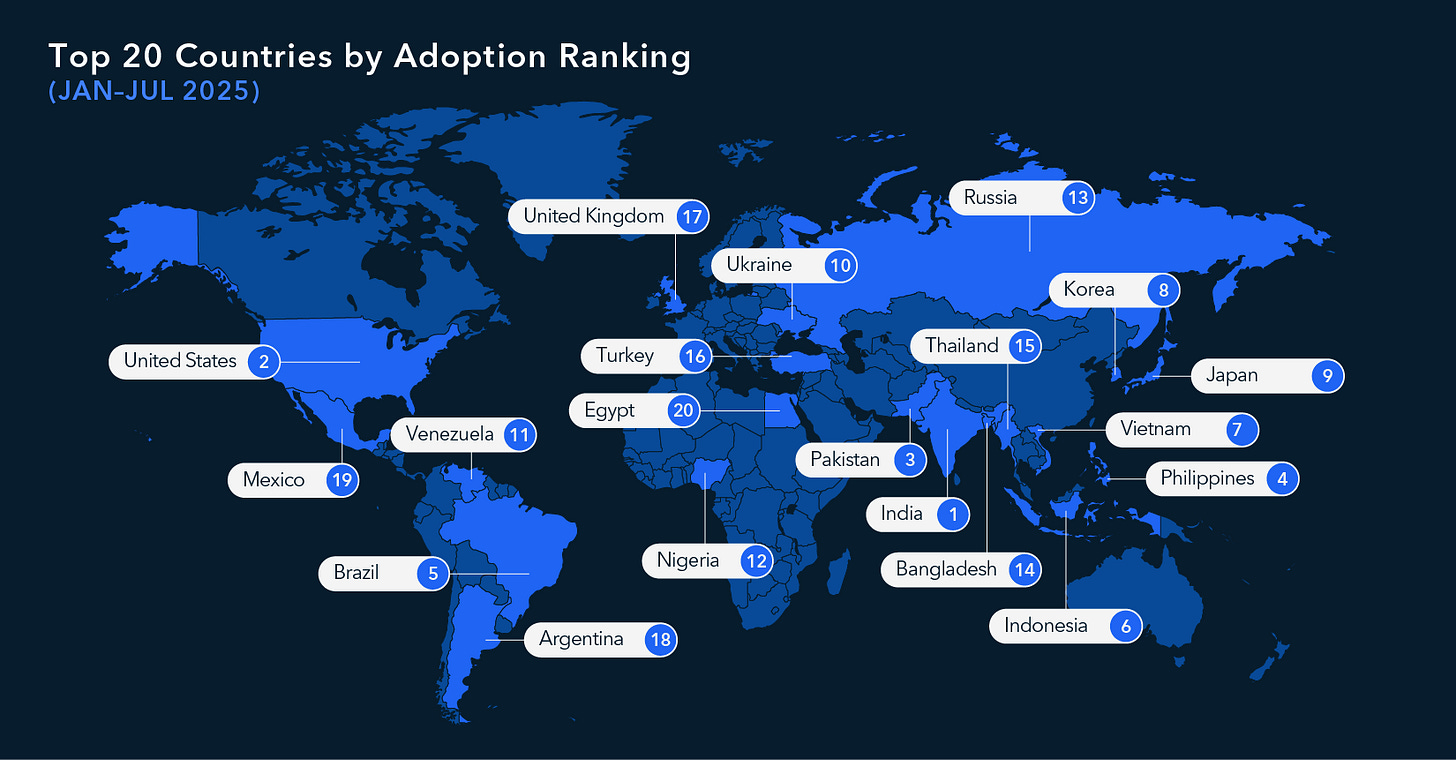
TRM Labs 2025 Country Crypto Adoption Index: 4th globally (up from 8th in 2024).
Crypto Friendly Cities Index 2025: 20th in crypto wealth concentration, with Filipino crypto holders averaging $14,194.46.
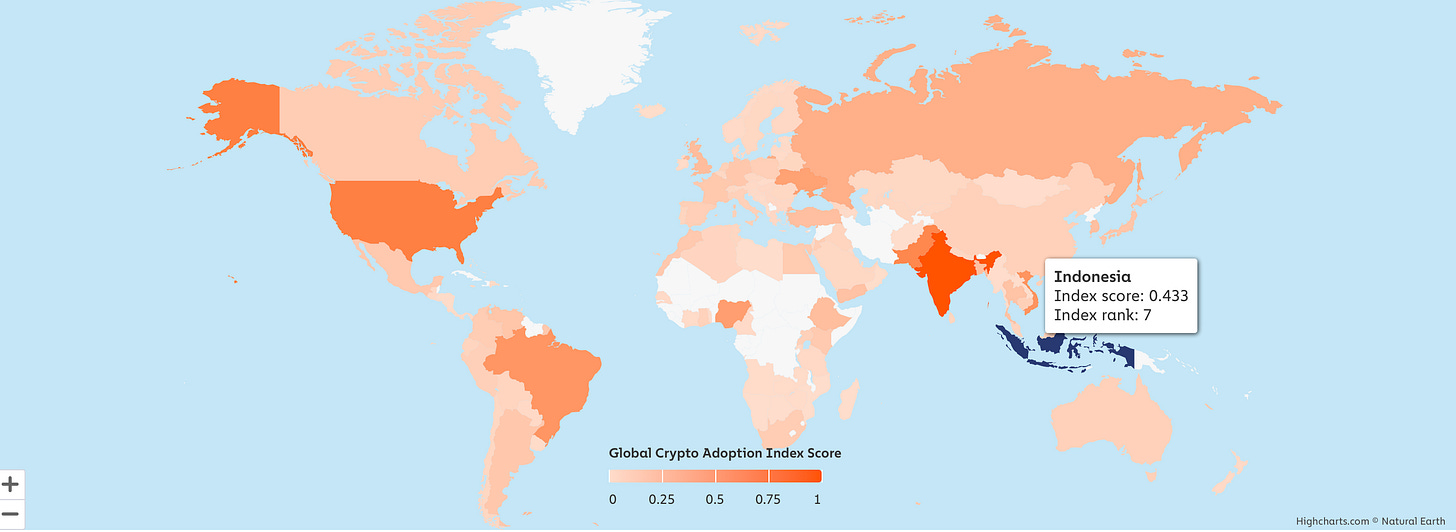
Use our interactive map to see where your country ranks on the 2025 Chainalysis Global Crypto Adoption Index
User Base and Market Size
Approximately 10% of Filipinos engage with cryptocurrency, projected to reach 12.79 million by 2026. The domestic crypto market in the Philippines is expected to grow from $49.85 billion in 2024 to $114.70 billion by 2033, representing a 9.68% CAGR.
Crypto adoption reflects deep structural realities:
One of the world’s largest diaspora communities sending billions in remittances.
Nearly half the population underserved by traditional banks due to its challenging island geography, socio-economic constraints and informal employment, lack of documentation, limited financial literacy, and the deep-rooted preference for cash-based transactions over formal banking services.
High smartphone and internet penetration.
A digitally literate and youthful population.
A culture that rapidly experiments with new income streams.
The Axie Infinity Effect
The Philippines has a very strong gaming culture and active Web3 game community. At its peak in 2021 (COVID times), nearly 40% of Axie Infinity’s global players were Filipino. This phase:
Normalized wallet usage.
Introduced millions to DeFi and tokens.
Built cultural familiarity with Web3.
Even though P2E speculation has faded, the literacy and habits remain.
2. Regulatory Landscape: A Paradox of Progress and Uncertainty
The Bangko Sentral ng Pilipinas (BSP), the country’s central bank, was an early mover, issuing Circular No. 944 (2017) to regulate VASPs (virtual asset service providers). Yet the environment today is widely viewed as a “quasi-legal realm”, crypto is neither banned nor fully legitimized
Recent developments:
BSP VASP Moratorium (renewed as of September 2025).
Securities and Exchange Commission (SEC) Action: ISP blocks + app delisting request for Binance, OKX, Bybit, KuCoin, Kraken.
Multiple Senate Bills proposing blockchain-based transparency, digital asset regulation, and stablecoin rails.
Worldcoin ordered to cease operations by the National Privacy Commission over Data Privacy Act violations.
While the Philippines lacks specific legislation regarding cryptocurrency taxation, the National Internal Revenue Code mandates that income derived from any source is subject to tax.
There is no explicit framework yet for DeFi, DAOs, RWAs, or Web3 infrastructure, creating uncertainty for builders, investors, and institutions, but a bill was filed in the 20th Congress to establish a national framework for digital assets and tokenized investments. Separately, House Bill 421 proposes establishing a national Bitcoin reserve of 2,000 BTC per year.
Key bodies shaping the ecosystem:
BSP (payments + VASPs)
SEC (CASP rules)
AMLC (compliance, monitoring)
NPC (privacy)
DICT (government blockchain adoption)
DOST (research + innovation)
3. Economic Engine: Stablecoins & Remittances
Remittance Powerhouse
The Philippines received about $38.34 billion in remittances in 2024, a 3% increase from the previous year. These funds from Overseas Filipino Workers (OFWs) remain a vital economic pillar and a lifeline for millions of households. To make cross-border transfers faster and cheaper, stablecoins are increasingly being used as an alternative to traditional remittance channels. In 2025, Coins.ph partnered with BCRemit to launch a stablecoin-based remittance rail that converts overseas transfers into USDC/USDT, moves them on-chain, and allows instant peso cashouts, reducing transfer fees by around 80%.
The Reality: Crypto Remittance Isn’t Always Cheaper: on-chain transfers are cheap, but off-ramps are expensive. In real-world conditions, bank-based remittance platforms like Xoom or Wise often outperform crypto off-ramps.
This contradiction shows that the promise is real, yet the infrastructure gap remains critical. Fixing off-ramp costs is one of the most important industry challenges.
The Unbanked Opportunity
With an estimated 49.8% of the population unbanked or underbanked, crypto infrastructure: wallets, stablecoins, tokenized savings products, offers an alternative to traditional banking barriers.
As of 2024-2025, digital payments account for roughly 57.4% of retail transactions, creating fertile ground for further crypto integration.
Cross-Border Payroll: Stablecoin payroll rails are emerging for freelancers and remote workers to avoid high bank fees and multi-day settlement.
Real-World Asset (RWA) Tokenization: The Philippines’ Bureau of Treasury has made government bonds available as tokenized assets on GCash, Unionbank, and PDAX. These RWAs have been sold to half a million Filipinos since it launched in July 2025. Additionally, the Securities and Exchange Commission revealed that one of the entities in its regulatory sandbox is a real estate tokenization project.
4. “Invisible” Ethereum: Government & Corporate Adoption
Unionbank i2i Project
In May 2018, UnionBank launched Project i2i in Davao City, an Ethereum-based payment platform developed with ConsenSys that connected rural banks to the national financial system. The platform operated independently of traditional payment infrastructures like PhilPass and SWIFT, addressing the challenge that 70% of Filipinos remained unbanked. Starting with five rural banks, the project became one one of the world’s earliest examples of enterprise Ethereum adoption.
Department of Budget Transparency on Polygon
The DBM’s system, implemented in partnership with BayaniChain and ExakIT Services, secures documents into NFT on Polygon, enabling citizens and auditors to instantly verify their authenticity and enhance public trust in government financial transactions.
The Cadena Act
A bill which seeks to institutionalize transparency in government spending. The measure mandates the creation of a digital budget portal to fully disclose government transactions, allowing citizens to track public funds and help prevent corruption.
Issued by the Bureau of the Treasury (BTr) in partnership with PDAX and GCash, nearly 50% of all government bondholders in the Philippines now hold their bonds in tokenized form.
Instead of requiring a bank account and a minimum investment of PHP 10,000 or more, users can buy government bonds for as little as PHP 500 (approximately $9).
“Project Bayani“: The $60 Billion Opportunity
A 2025 study by PDAX, Onigiri Capital, and Saison Capital to transform Philippine finance by tokenizing $60 billion in assets by 2030, enabling millions to access investment products via blockchain.
Several Philippine peso-backed stablecoins have been introduced, including PHX (UnionBank, 2019; inactive), PHD (UnionDigital, 2022; stalled), C Peso (C Pass, 2022; inactive), PHMU (DA5/Gurufin, 2023; no launch), PHPC (Coins.ph, 2024; on Polygon and Ronin), PUSO (Celo, 2024; remittance-focused), and PHPX (UBX/RCBC et al., 2025; pending BSP approval), but no peso stablecoin has yet achieved meaningful traction due to regulatory caution, trust concerns, no clear commercial use cases…
5. Ethereum Startup and Infrastructure Ecosystem
Centralized Exchanges and Wallets
BSP-licensed VASPs serve as the country’s safest fiat-crypto on-ramps amid an ongoing moratorium on new licenses. The Philippines has a diverse set of regulated crypto gateways, each serving different segments of the market.
GCash (Mynt): The largest e-wallet in the Philippines, integrating accessible crypto trading that is powered by PDAX for millions of Filipinos.
Coins.ph: An established custodial crypto wallet with more than 16 million users, now backed by deep capital following its acquisition by former Binance CFO Wei Zhou.
Maya: A fully licensed digital bank with seamless banking-to-crypto features.
GoTyme Bank: Recently launched “Go Crypto” in October 2024, enabling direct PHP-to-crypto trading for 11 major cryptocurrencies inside a regulated digital bank.
PDAX: Compliant order-book exchange with support for digital assets and tokenized financial products. Key player in tokenized treasury bonds initiative.
Moneybees serves as the country’s primary OTC crypto network.
UnionBank remains one of the most crypto-friendly banks supporting the broader ecosystem.
The Offshore Reality: Despite the presence of licensed VASPs, many Filipinos still on-/off-ramp through unlicensed global exchanges. This is reflected in the SEC’s public advisories and ISP blocks against platforms like OKX, Bybit, and KuCoin. Deeper liquidity and wider asset availability continue to pull users toward these offshore venues.
Web3 Gaming Infrastructure
The Philippines remains the incubator for startups focused on building tools for large-scale Web3 community management.
Yield Guild Games (YGG): The pioneering Filipino-led gaming guild that standardized the P2E scholarship model globally. YGG has now pivoted to become a decentralized autonomous organization (DAO) focused on infrastructure and tooling for the “Play-to-Own” future.
Sovrun (formerly BreederDAO): Previously specialized as an NFT asset factory but now producing optimized digital assets at scale for blockchain games and virtual worlds.
DeFi & Payments Infrastructure
Rampz: Decentralized peer-to-peer platform for on-ramping and off-ramping.
Sparkpoint: A full-stack ecosystem combining payments, DeFi, wallet infrastructure, education, and (recently) AI + blockchain tooling.
Dev Shops
Nuxify: A Davao-based software development and solutions firm that builds Web3 and blockchain products on the EVM and in the Ethereum ecosystem.
Bayanichain: Infrastructure provider tokenizing government and enterprise systems, including DBM documents migrated to Polygon for efficient on-chain access.
Digital Credentials & Identity
Certifika: A homegrown Web3 startup from Mindanao focused on issuing verifiable, tamper-resistant digital certificates and credentials.
Media
Majority of Filipinos get their news on crypto social media like Facebook and Twitter. Here’s a non-exhaustive list of media platforms in the Philippines: BitPinas, BitDigest, PhilStar Tech, The Cryptology Academy, YGG Alerts, Decrypt, and credible key opinion leaders like Luis Buenaventura.
Education
6. Community & Education: Cultivating the Builder Pipeline
The Early Days
The Philippine Ethereum ecosystem started around 2015 with grassroots meetup groups like Manila Ethereum and Makati Digital Currency, where early enthusiasts organized the country’s first blockchain-focused meetup and hackathon to educate developers about smart contracts and decentralized applications.
Current Grassroots Communities
Ethereum Philippines (ETHPH), originally ETH63, is the schelling point local community. Through close collaboration with local groups like the Davao DeFi Community (DDC) and Cebu Tech Communities (CTC), they drive Ethereum workshops, developer tracks, university programs, and meetups across the country. Layer-2 aligned groups like Base Philippines, Arbitrum PH, Celo PH, and Lisk SEA complement the broader Web3 ecosystem with their own community meetups and initiatives.
Events: ETHPH organized long-term, developer-focused programs across Manila, Cebu, Baguio, and Mindanao beginning in 2024. These included month-long technical deep-dives like Infinite Hack, Proof of Teach with the instructors of 20+ universities in Mindanao, and the first workshop on modern cryptography, Cipher Cebu.
Web2 Developer Communities
Alongside Web3 communities, the Philippines also has a strong network of traditional developer and tech groups that indirectly support Ethereum talent growth. These include ecosystems like Google Developers Group (GDG), AWS Community, Devcon PH (distinct from Ethereum Devcon), and the multiregional FOSSASIA, as well as active regional programming groups such as PizzaPy, DurianPy, SugarPy, and other Python, Linux, and open-source circles. The Game Developers Association of the Philippines (GDAP) and local tech communities in major cities contribute additional developer pipelines, while government-backed programs like START under DOST help strengthen STEM capacity and regional tech education.
Web3 Developer Gap
Despite having one of Southeast Asia’s largest software developer bases, the Philippines faces a significant blockchain developer gap. This gap persists despite high retail crypto adoption because:
Trading and speculation overshadow builder culture.
Limited blockchain education in university curricula.
Brain drain to other opportunities in AI and Cybersecurity.
Limited financial safety nets, many prefer stable, good-paying roles rather than volatile startup environments.
However, the ecosystem is rapidly addressing this through grassroots education initiatives, university partnerships, and developer bootcamps focused on Ethereum and EVM-compatible chains.
University & Academia
Strong CS/IT/engineering foundations exist at top universities (UP, ADMU, DLSU), but blockchain education lags. Universities in Mindanao like USEP show relative momentum via grassroots ETHPH-led SpeedRun Ethereum workshops.
7. Acceleration & Investment: Capitalizing the Ecosystem
Incubators & Accelerators
Archipelago Labs (A-Labs): Incubate and invest in startups and ideas focused on consumer applications, infrastructure & tools, Web3, and digital experiences.
Lisk SEA: Southeast Asia program providing full lifecycle support for blockchain startups building on the Lisk ecosystem.
Active International VCs: Animoca Brands (backed YGG and gaming infrastructure), Hashed and others.
Local Incubators & Innovation Hubs: Several Philippine incubators with strong Web2 backgrounds have shown interest in supporting Ethereum and Web3 startups, including: Marian TBI (Technology Business Incubator at UIC), Upgrade Innolab and IDEAS Davao.
Angel Investors: Gabby Dizon (Co-founder of YGG), Luis Buenaventura (ex-YGG Pilipinas Country Manager, Head of Crypto at GCash), Nichel Gaba (PDAX CEO) and others.
The Investment Gap: Philippine Web3 remains underfunded versus regional peers (Singapore, Vietnam, Indonesia) due to limited local crypto-native VCs, regulatory uncertainty deterring institutional capital, brain drain to crypto-friendly jurisdictions, and market perception challenges despite high retail adoption.
8. Challenges & Path Forward
Critical Challenges:
Regulatory Uncertainty: BSP moratorium, SEC enforcement, no DeFi/DAO frameworks, inconsistent tax compliance.
Infrastructure Gaps: Expensive off-ramps negating stablecoin benefits, limited banking integration, custodial vs. non-custodial education deficit.
Talent Drain: Developer shortage, university curriculum lag, migration to AI/cybersecurity or foreign jurisdictions.
Capital Scarcity: Nascent VC ecosystem, limited exits creating LP base, funding gaps versus regional competitors.
Unique Opportunities:
Proven Retail Adoption: 12M+ crypto-native users with established wallet habits and Web3 literacy.
Massive Addressable Market: 49.8% unbanked population, $38B remittance flows, 57.4% digital payment penetration.
Government Validation: Operational blockchain systems (budget transparency, tokenized bonds) proving institutional viability.
Competitive Advantages: English proficiency, youthful population (median age 26.1), gaming culture, technical talent at lower costs than regional peers.
9. Further Reading
Transformation Under Way in Philippines as Crypto Market Matures, by Crypto Council for Innovation.
Project Bayani by PDAX, Saison Capital, and Onigiri Capital.
Select Philippine Budget Documents Now on the Blockchain by BitPinas.
Thanks for reading, and have a nice day! 🌸
Best regards,
Riely and the Geode Labs team.
Have any comments or feedback? DM.
Want to advertise on Local Ethereum? DM or Email.
If your company is interested in reaching an audiences of regional community and ecosystem builders, developer communities, universities, startup partners, or policymakers, you may want to advertise with us.

Riely
Riely is the Editor in Chief of Local Ethereum, covering Ethereum and crypto adoption stories from around the world. Based in Berlin, she covers stories from India, Argentina, Poland, Taiwan, Serbia, and beyond, with a focus on how decentralized technology intersects with local culture, economics, and politics.
Published December 5, 2025 · 11 min read
Local Ethereum
Enjoying the read? Get this in your inbox.
In-depth Ethereum ecosystem coverage: regional deep dives, monthly roundups, and global analysis. Twice a month, free.
Subscribe, it's free