Regional Deep Dive Riely·January 30, 2026·7 min read
Vietnam Ethereum Ecosystem Overview Part I
Special thanks to Jade Hoang, Kim Trong, Phuc Thai, Trong Nguyen, Sasha Mai, Vi Vi, Mary Tran for the feedback and the review.
TL;DR
Adoption paradox: Vietnam ranks #4 globally in Chainalysis’s adoption index despite legal restrictions on crypto payments, largely organic and retail-driven.
Notable projects: Kyber, Pendle, Axie Infinity, Orochi Network, NE (previously Coin98), Coin68, etc.
Gaming-driven engagement: Play-to-earn games like Axie Infinity catalyzed massive retail onboarding (2020–2022).
Developer dynamics: Strong dev talent, but many work for outsourcing companies; Vietnamese builders on Ethereum often operate outside large, visible communities.
Regulatory uncertainty: Despite ongoing regulatory uncertainty and prohibited crypto payments, Vietnam shows early openness through its new Digital Technology Law (June 2025, effective January 2026) and IFC sandbox initiative.
Comprehensive ecosystem: DeFi/GameFi/infra startups (Kyber, Pendle, Axie, Orochi), venture capital (Kyros Ventures, Caliber, Coin98 Ventures), academic cryptography research (VIASM, HCMUT, HUST, VNU, ZKP Labs), media (Coin68, Coin98 Insights), and enterprise players (FPT, SotaTek).
ZKP/cryptography foundation: Positioned as Southeast Asia’s premier crypto development hub with notable strength in zero-knowledge research.
Infrastructure focus: Early Vietnamese teams built L1s (when L2s were nascent); more recent projects have shifted toward L2 and application-layer development.
1. Adoption Metrics
Global Rankings:
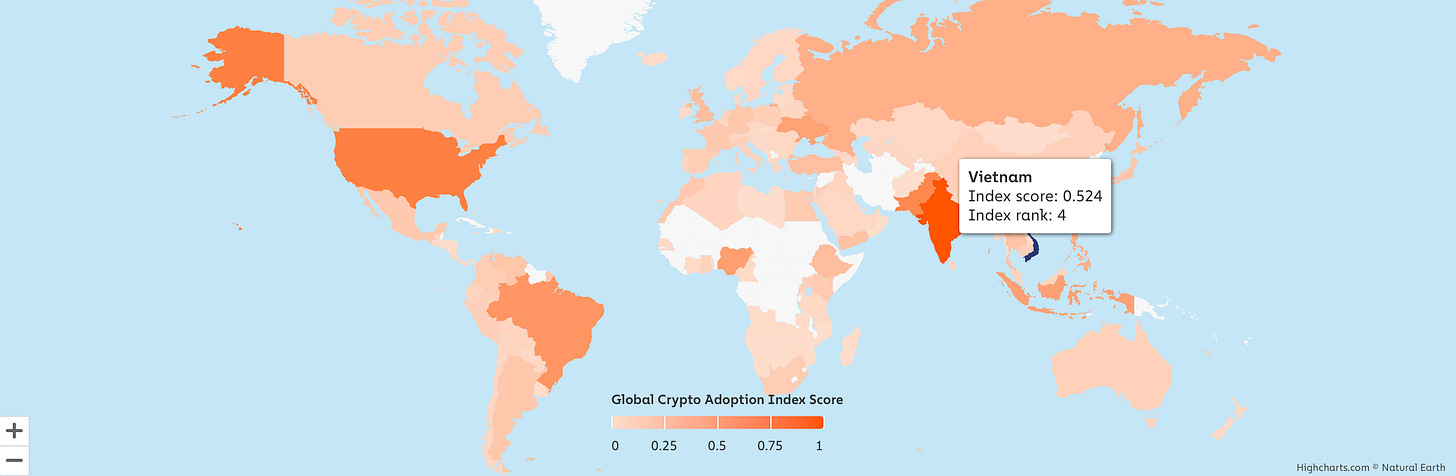
Chainalysis 2025 Global Crypto Adoption Index: 4th globally, up from 5th (2024), down from 3rd (2022)
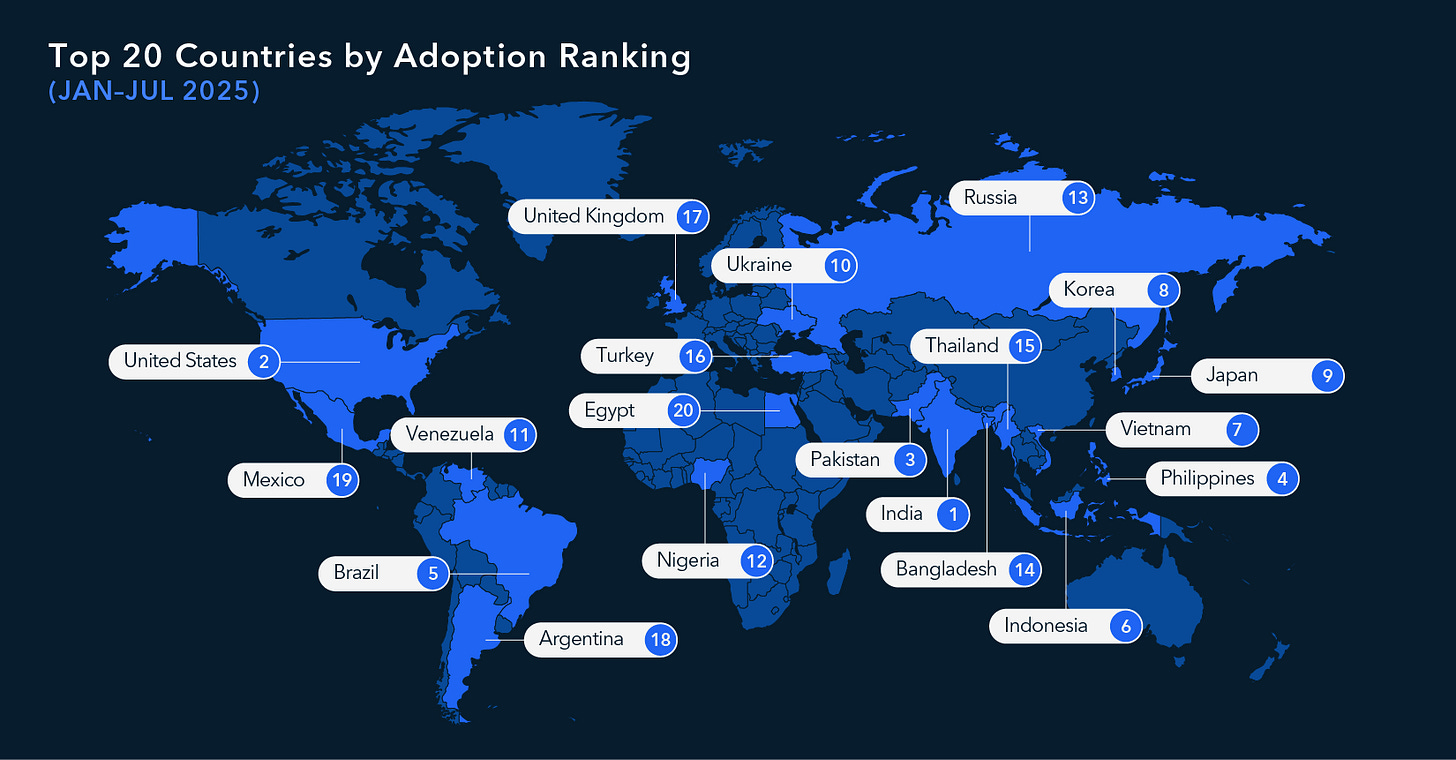
TRM Labs 2025 Country Crypto Adoption Index: 7th globally, down from 5th (2024)
2. Why Vietnam’s crypto adoption is so high
Limited productive investment options meet high savings rate: Vietnam has one of Asia’s highest savings rates at 25-30% of GDP, but people have limited good options. The stock market is volatile and retail-dominated. Capital controls make investing abroad difficult.
Frictionless access and regulatory gray zone: Crypto infrastructure just works in Vietnam. Binance and major exchanges operate smoothly, on-ramps are simple, and you can start with just a few dollars. While the domestic stock market runs on T+2 settlement, crypto’s 24/7 trading and volatility appeal to retail traders. Crucially, the regulatory environment is a gray zone - not banned like China, not fully legitimized - which lets people use crypto freely without barriers or institutional gatekeeping.
Appeal to young growth-seekers: The crypto adopters are predominantly young, mobile-native millennials and Gen Z (not the traditional gold buyers or conservative investors). With a median age of 33.5, a population of 102.3 million, and 84% internet penetration, the demographic conditions favor digital asset adoption among those drawn to crypto’s high-return potential over more conventional options.
Proven builder ecosystem through DeFi and GameFi: High-profile successes like Loi Luu’s Kyber Network and Trung Nguyen’s Axie Infinity showed Vietnamese founders a path to wealth, inspiring many to follow. While Axie’s user boom during COVID happened mainly in the Philippines, the Vietnamese-founded project sparked a wave of local GameFi development in 2021, some finding decent success before the sector died off. These wins proved that local teams could build globally relevant products, attracting serious technical talent to the space.
3. Regulatory Landscape: Shift From Grey Market to Regulated Crypto Industry
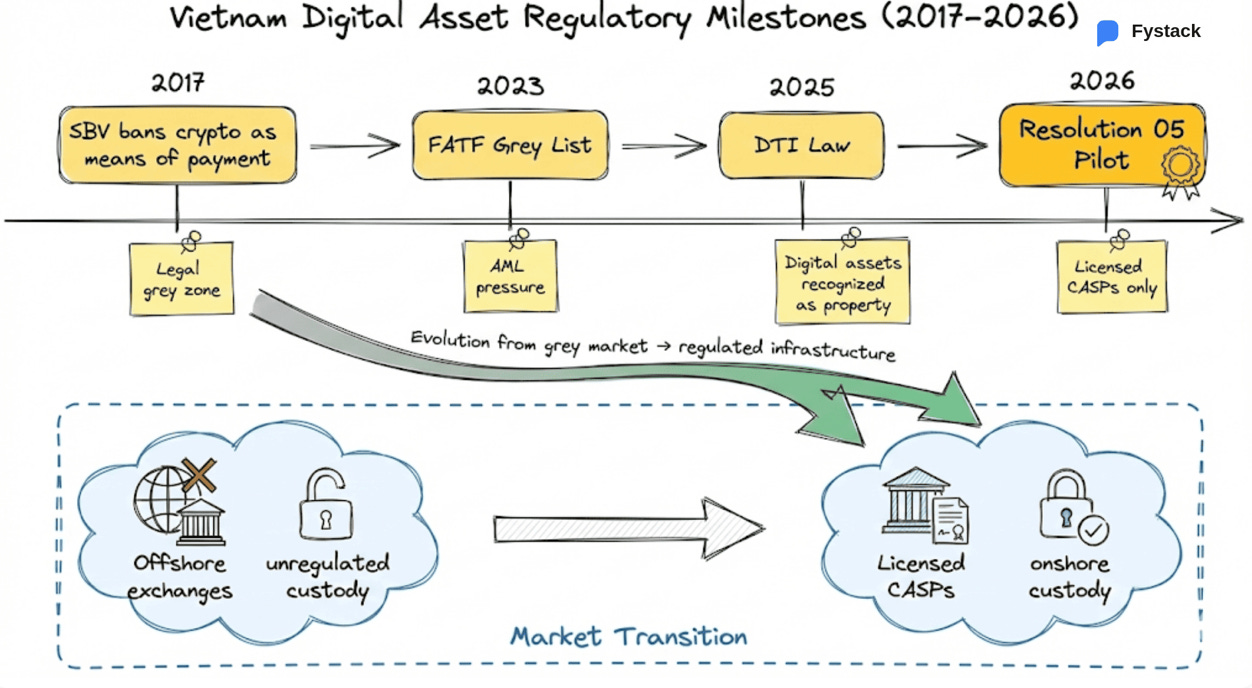
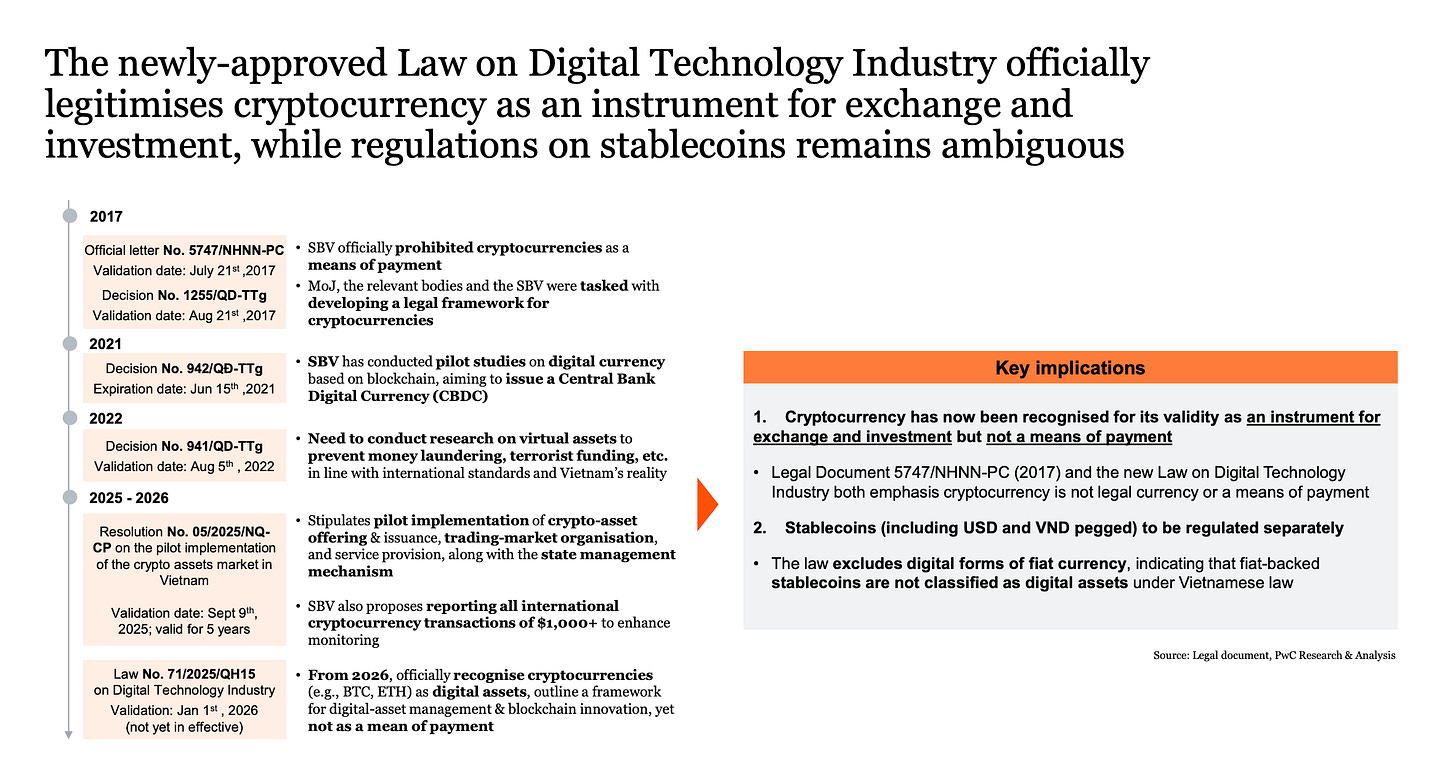
Vietnam’s cryptocurrency regulation shifted decisively in 2025 from legal ambiguity to controlled legitimization. Historically, since 2017 it prohibited crypto as payment while leaving trading and ownership legally undefined, which can create a massive shadow economy.
The breakthrough came June 14, 2025, when the Law on Digital Technology Industry recognized digital assets as “property” under the Civil Code for the first time (effective January 1, 2026), though crypto remains NOT legal tender.
Resolution 05/2025/NQ-CP (September 9, 2025) operationalized a five-year pilot with strict requirements: exchanges need VND 10,000 billion minimum capital (~$378M USD), 65% institutional ownership, 49% foreign ownership cap, and Ministry of Finance licensing. Only Vietnamese enterprises can issue real asset-backed crypto assets. Foreign investor participation is restricted, and the same tax regime as securities transactions temporarily applies (e.g., 0.1% on transaction value).
Impact:
Policy prioritizes institutional control, FATF compliance, and user protection, favoring stability and fraud prevention over capital inflows and investor enthusiasm.
Traders & Users: Legal recognition of digital assets as property boosts legitimacy and combats scams, with domestic/foreign users able to trade via MOF/IFC-licensed CASPs (post-6-month grace period); mandatory AML/KYC, 0.1% transaction taxes, and penalties curb P2P/grey-market activity, enhancing security but restricting informal volumes.
Startup founders: cannot access exchange licensing due to the VND 10T (~$378M) capital barrier or conduct traditional ICOs, as token issuances require licensed platforms only. Local Vietnamese GameFi projects and devshops face shutdown pressure, several have already suspended services early this year, unable to meet compliance demands.
Investors see clarity and limits
Investors (Foreign): The 49% foreign ownership cap plus data localization requirements under Decree 53 mandating user data stored within Vietnam means you can’t just parachute in, you’ll need local Joint Venture structures and onshore infrastructure.
This reinforces the existing pattern: incorporate in Singapore for regulatory clarity and capital access, operate teams in Vietnam for talent and market proximity.
It gives room for innovation under Resolution No. 222/2025 on International Financial Centers, e.g., Members can conduct transactions such as payments, transfers with each other and with foreign entities.
4. Key Local Startups
OG DEX aggregator on Ethereum, founded in 2017 by Vietnamese founders Loi Luu and Victor Tran.
Served as a talent incubator for Vietnam and SEA’s DeFi ecosystem. Kyber alumni are founders and core contributors behind RISE (L2), Pendle (yield protocol), Jupiter (DEX), and Tokenlon (DEX).
Axie Infinity (Sky Mavis)
A blockchain game developed by Vietnamese studio Sky Mavis in 2018, co-founded by Trung Nguyen (CEO) in Ho Chi Minh City.
Ronin transitioned from a sidechain to a full-fledged L2 built to scale Ethereum gaming in 2025. 1M wallet downloads and $4.2B in NFT trading volume on App.axie, the #1 NFT project by all-time volume.
Ninety Eight (previously Coin98)
A DeFi super app integrating wallet, DEX, and cross-chain bridge, founded by Le Thanh, a Vietnamese engineer who started as a YouTube crypto educator in 2017.
Verifiable data infrastructure using Zero-Knowledge Proofs, founded in 2021 by Chiro Hiro and Mary Tran in Ho Chi Minh City.
Raised $20 million total; zkDatabase has processed 700+ million proofs since launch.
Major dev shop with a dedicated blockchain division.
Vietnam’s largest IT company.
Built akaChain (Hyperledger Fabric) and eTradevn (first blockchain L/C platform). Actively expanding blockchain services.
HCMC-based security firm specializing in blockchain and cryptography.
A Da Nang–based Web3 company founded in 2021. Flagship product Copin is a data platform for on-chain perpetual trading, alongside Mintty, Trustgem, TrueDrop, and other internal initiatives.
5. Institutional & Public Sector Adoption
Banking & Finance
Vietnamese banks are not crypto-friendly, though bankers are generally open-minded toward blockchain technology. Major banks (Vietcombank, BIDV, etc.) do not support crypto transactions.
P2P transfers are permitted, but banks internally flag transactions containing keywords like “crypto” or “bitcoin” for monitoring - particularly if linked to suspicious fund sources. This is informal bank policy rather than official government regulation (confirmed via banking contacts). Accounts can be frozen at police request for money laundering investigations, not crypto activity per se.
The core issue: Vietnam lacks licensed on/off-ramps, pushing users to P2P and informal OTC channels where fund provenance is harder to verify. Legitimate traders risk getting caught up when counterparties have tainted funds.
Real-World Assets (RWA): Not an active sector yet.
Despite crypto restrictions, Vietnamese banks are actively deploying blockchain use cases:
Vietcombank: Applied blockchain to Letters of Credit, cutting processing from 3-5 days to 27 minutes.
VietinBank: Streamlined the duration of both domestic and international interbank transactions from 5-7 working days to just 24 hours through blockchain implementation.
TPBank: The first bank to successfully implement international money transfers via Blockchain through RippleNet.
Techcombank: Through its subsidiary TCBS, successfully implemented blockchain technology in bond management (Blockchain-enabled Bond) and iXu reward point system (Blockchain-enabled iXu).
Corporate/Enterprise
Limited exploration of public blockchain (including Ethereum) due to legal concerns
FPT Group (tech conglomerate): Enterprise blockchain focus, primarily Hyperledger.
SotaTek: IT services and consulting firm, a subsidiary of Sota Holdings.
Government - NDAChain
Layer 1 permissioned blockchain using Proof-of-Authority (PoA) consensus, enhanced with Zero-Knowledge Proofs (ZKP) for privacy.
49 public-private validator nodes; average of 1,200 TPS.
Developed by National Data Association; operated by Data Innovation and Exploitation Center (under Ministry of Public Security).
Products: NDA DID (decentralized identity for verifying counterparties, integrated with VNeID), NDATrace (product verification and traceability), and NDAKey (quick identity authentication app).
Goal: Build Vietnam’s sovereign digital infrastructure, the verification layer for e-government, finance, healthcare, and logistics, ensuring data security, transparency, and trust.
What’ Next?
In Part II, we will walk you through Vietnam’s investment landscape, developer events and education, regional hubs, and other deep dives. 🇻🇳
Thanks for reading, and have a nice day! 🌸
Best regards,
Riely and the Geode Labs team.
Have any comments or feedback? DM.
Want to advertise on Local Ethereum? DM or Email.
If your company is interested in reaching an audiences of regional community and ecosystem builders, developer communities, universities, startup partners, or policymakers, you may want to advertise with us.

Riely
Riely is the Editor in Chief of Local Ethereum, covering Ethereum and crypto adoption stories from around the world. Based in Berlin, she covers stories from India, Argentina, Poland, Taiwan, Serbia, and beyond, with a focus on how decentralized technology intersects with local culture, economics, and politics.
Published January 30, 2026 · 7 min read
Local Ethereum
Enjoying the read? Get this in your inbox.
In-depth Ethereum ecosystem coverage: regional deep dives, monthly roundups, and global analysis. Twice a month, free.
Subscribe, it's free