Regional Deep Dive Riely·February 3, 2026·5 min read
Vietnam Ethereum Ecosystem Overview Part II
This piece continues our Vietnam Ethereum Ecosystem deep dive. In Part I, we looked at the foundations of Vietnam’s Ethereum ecosystem that made Vietnam one of the most underestimated crypto markets globally.
If you haven’t read it yet, we recommend starting there!
Special thanks to Jade Hoang, Kim Trong, Phuc Thai, Trong Nguyen, Sasha Mai, and Tuyen for the feedback and the review.
6. Investment Landscape
Vietnam’s crypto investment scene has cooled since new regulations cracked down on ICOs, IDOs, and scam projects, making token launches explicitly illegal, previously a gray area where rug pulls went largely unpunished.
Post-regulation, participants in scam projects (especially GameFi teams) face lawsuits, with many cases emerging since January; VCs investing in dubious projects can still profit but risk legal exposure if unaware of fraud.
Local VCs
Coin98 Ventures: Active local crypto VC with 100+ portfolio companies
Kyros Ventures: Early-stage incubator backed by Coin68 ecosystem, produces market research
Kyber Ventures: Investment arm of Kyber Group, supporting DeFi ecosystem
Caliber: Web3 venture builder by Kyber Network
International Funding
Most Vietnamese crypto startups raise from Singapore/US VCs. Vietnamese projects have attracted funding from Animoca Brands, Binance Labs, Pantera Capital, Hashed, Alameda Research (pre-collapse).
7. Developer Events & Education
Developer & Builder Community
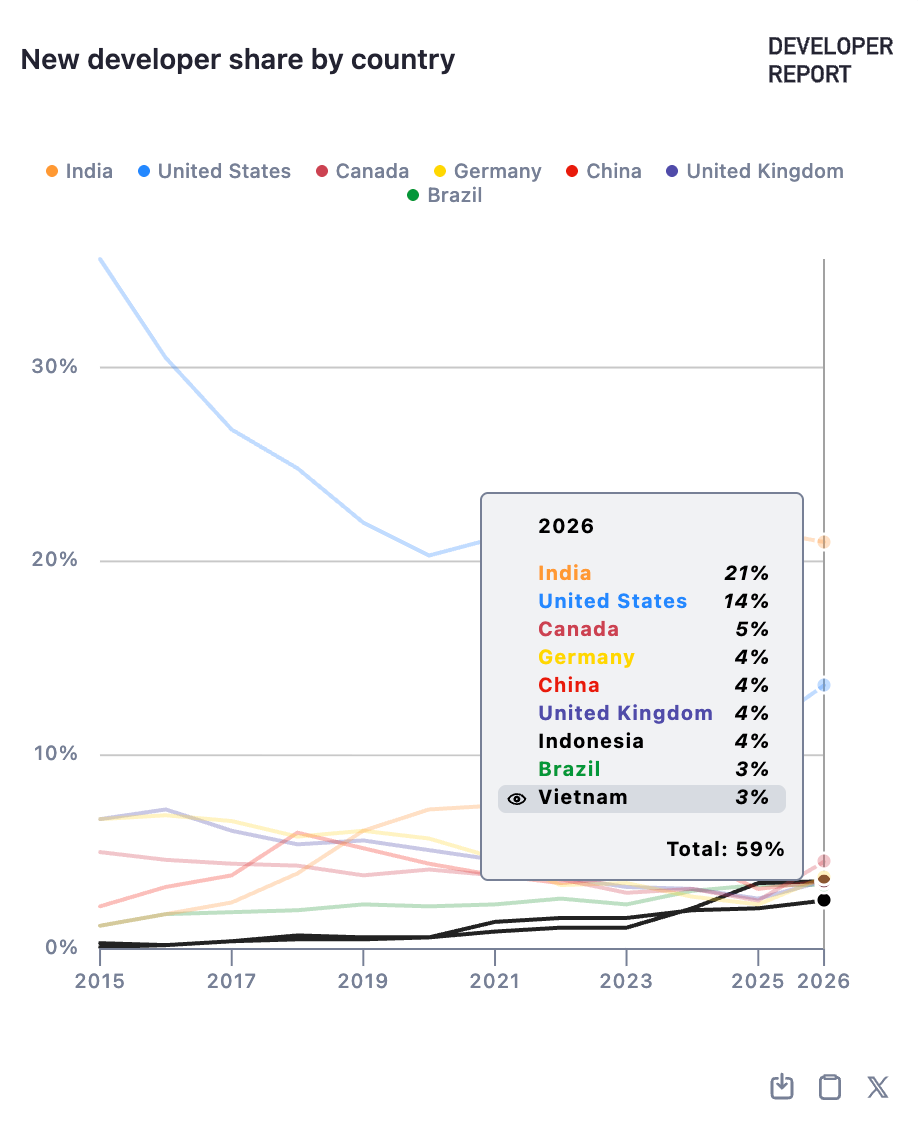
Vietnam ranks 8th globally for new blockchain developer share (3%), alongside Germany, Indonesia, China, Canada, and Turkey, trailing only India (22%) and the US (14%)
Strong talent in gaming/frontend, cryptography and security, weaker in protocol development
A significant portion of Vietnam's local software developers work for outsourcing giants like FPT, TMA, CMC Global and KMS, which dominate the IT sector
Best developers often relocate or work remotely for foreign companies. Those staying in Vietnam tend to maintain a low profile
Communities and events
ETHVietnam: Annual hackathon/conference (started 2023)
GM Vietnam: Vietnam Blockchain Week, Multi-chain event
Super Vietnam: Blockchain, RWA & AI Week - tradefi and crypto enterprises focus
Conviction: Vietnam Digital Asset Economy Forum
Web3 Builders’ Summit: Annually summit held in Da Nang since 2024, gathers founders and developers to discuss blockchain and AI integration
Other communities include Web3 Saigon, sqrDAO, APAC DAO, though activity has declined. Various L2 groups (Starknet VN, Scroll VN) became less active after the ICO era. Base appears to be the most active L2 community currently.
University engagement
Education gap: Few universities offer blockchain-specific courses. Most of the devs are self taught through online course.
Vietnam National University (Hanoi): Occasional blockchain courses
RMIT Vietnam: Fintech program touches on blockchain
Key universities targeted by crypto companies for talent recruitment:
Ho Chi Minh City University of Technology (HCMUT)
Hanoi University of Science and Technology
Ho Chi Minh City University of Science (HCMUS)
VNU Hanoi University of Science (VNU-HUS)
VNU University of Engineering and Technology (VNU-UET)
Da Nang University of Science and Technology (DUT)
VIASM (Vietnam Institute for Advanced Study in Mathematics) is a premier research institute that has hosted IACR-VIASM Summer Schools on Cryptography (2016, 2022) focusing on lattice-based cryptography and Zero-Knowledge Proofs, connecting Vietnamese mathematicians with the global cryptography community. It serves as a critical academic foundation for Vietnam’s blockchain and ZKP talent pipeline, a schelling point for local zk builders! ✨
8. Regional Hubs
Vietnam’s blockchain activity centers on three cities: Ho Chi Minh City (Saigon) serves as the primary development hub, Hanoi is key for government relations/ policy and uni, and Da Nang is emerging as a tech city with sandbox initiatives.
9. Challenges
Uncertain Policy → New Framework, Uncertain Implementation: Previously, the absence of a clear legal framework discouraged VC investment and deterred top talent. While the Law on Digital Technology Industry (effective Jan 1, 2026) and Decision 96/QD-BTC (effective Jan 20, 2026) have finally opened a licensing pathway, the “uncertainty” has transitioned into execution risk. The primary challenge is whether these official platforms can offer the variety and depth required to keep users from returning to the now “legally high-risk” gray market. For local startups, particularly those building DeFi or DEX infrastructure, the regulatory stance can make their work more difficult (harder to attract VCs, harder to conduct an ICO, harder to hire top talent…)
The “Trust Deficit” & Brand Dilution: High-profile scams have left lasting skepticism among both users and policymakers. For users, this creates a much higher barrier for trusting new, local projects. For policymakers, this history has driven a “permission-first” regulatory approach. However, the new policy targeting scammers is a positive signal; it provides a protective floor for users and legitimate local players like Kyber Network, which may eventually unlock the ecosystem’s full potential.
Talent Pipeline & Developer Barriers:
Vietnam has a strong technical foundation, but growth is limited by market perception and opportunity.
Compared to established fields like Gaming or AI, blockchain currently offers fewer stable career paths. Vietnamese developers are practical; they gravitate toward industries with clear professional progression.
Crypto’s scam-heavy reputation further discourages elite developers who want to protect their professional standing.
Furthermore, formal blockchain education is limited, and the dominance of English-language documentation creates a steep learning curve for local talent.
The result: a) Founders incorporate offshore to mitigate legal uncertainty. b) Developers work for foreign firms that pay significantly more.
User Education & Use Case Gap: Education is “trade-centric.” Most users stay within the safety of CEXs, lacking the technical literacy to use self-custody or on-chain protocols. DeFi really works, but many users are looking for short-term gains. Real world use cases like remittance demand exists, but crypto off-ramp costs remain uncompetitive against traditional services like Wise. Startups lack incentive to build utility-focused products when user demand centers on quick trading gains.
10. Further Reading
Vietnam’s Crypto Legislation Opens Door to New Business Opportunities by Crypto Council for Innovation
Five reasons why Vietnam’s crypto usage is so high by Crypto Council for Innovation
Resolution 222/2025 original, Resolution on International Financial Centers (IFCs) in Ho Chi Minh City and Da Nang
Resolution No. 222/2025 on International Financial Centers by PwC Vietnam Newsbrief
Vietnam Crypto Market 2025: Complete Analysis of 21 Million Investor by Tiger Research
Blockchain in Banking: Challenges and opportunities for the banking system in Vietnam by Nguyen Thi Phan Thu
Is Vietnam Southeast Asia’s Next Web3 Growth Engine by Republic
Thanks for reading, and have a nice day! 🌸
Best regards,
Riely and the Geode Labs team.
Have any comments or feedback? DM.
Want to advertise on Local Ethereum? DM or Email.
If your company is interested in reaching an audiences of regional community and ecosystem builders, developer communities, universities, startup partners, or policymakers, you may want to advertise with us.

Riely
Riely is the Editor in Chief of Local Ethereum, covering Ethereum and crypto adoption stories from around the world. Based in Berlin, she covers stories from India, Argentina, Poland, Taiwan, Serbia, and beyond, with a focus on how decentralized technology intersects with local culture, economics, and politics.
Published February 3, 2026 · 5 min read
Local Ethereum
Enjoying the read? Get this in your inbox.
In-depth Ethereum ecosystem coverage: regional deep dives, monthly roundups, and global analysis. Twice a month, free.
Subscribe, it's free