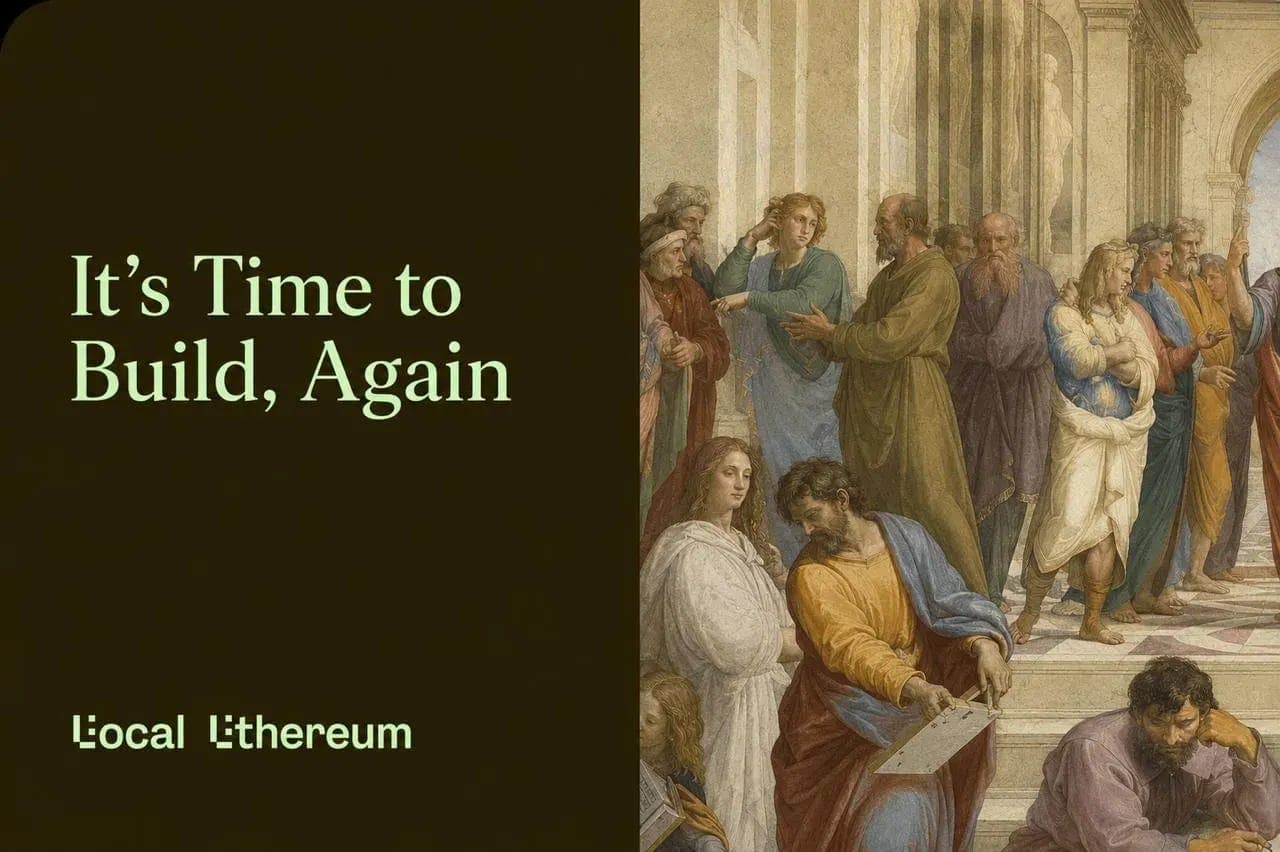
If you work in crypto, you probably have an easy answer for why it matters: it’s faster, more efficient, and removes intermediaries.
That answer is not wrong. It is just incomplete.
The people who built it believed that some forms of human freedom require systems that cannot be shut down by fiat, rewritten by decree, or accessed only with permission. That idea didn’t begin with Bitcoin. It has a longer history, and it is worth revisiting.
Subscribe now
1. True Names, Vernor Vinge, 1981
Topic: Fiction, pseudonymity, cyberspace before it had a name.
Pair with: William Gibson’s Neuromancer (1984), which popularized the concept of cyberspace, and True Names and the Opening of the Cyberspace Frontier (2001).
Why it matters:
A hacker called Mr. Slippery lives two lives. Online, he is powerful. In the physical world, he is ordinary. That gap protects him. Then the government learns his true name, and the story makes its point: they do not need to defeat him with force or technology. They only need to know who he is.
Vinge saw early that identity is leverage. Once your real name is known, anonymity becomes fragile, and autonomy becomes negotiable. Cypherpunks understood this immediately. So did Satoshi, whose true name we still don’t know.
Best quote:
In the once upon a time days of the First Age of Magic, the prudent sorcerer regarded his own true name as his most valued possession but also the greatest threat to his continued good health.
Read here: True Names on Goodreads, or find it at your local bookstore.
2. A Cypherpunk’s Manifesto, Eric Hughes, 1993
Topic: Privacy, code, the movement.
Pair with: Philip Zimmermann’s “Why I Wrote PGP“ (1991), the code came before the manifesto; “The Ethereum Cypherpunk Manifesto“ (2024), the same spirit, published onchain.
Why it matters:
This is the founding document. Hughes makes the core argument with unusual clarity: in the electronic age, every transaction reveals information about you, and nobody will protect that information for you. Not governments. Not corporations. You have to defend your own privacy.
Then comes the line that defined the movement: “Cypherpunks write code.” Not petitions. Not lobbying. Code. Publish it. Make it hard to shut down. Everything else on this list follows from that idea.
Best quote:
We cannot expect governments, corporations, or other large, faceless organizations to grant us privacy... We must defend our own privacy if we expect to have any.
Read here: cypherpunk-manifesto.txt
3. Libertaria in Cyberspace, Timothy C. May, 1992
Topic: Sovereignty, decentralization, mathematics, the future of societies.
Pair with: May’s “Cyberspace, Crypto Anarchy, and Pushing Limits“ for the mechanism behind the vision; Vitalik’s “Let a thousand societies bloom“ for how it evolved.
Why it matters:
By 1992, the cypherpunk vision was already becoming coherent. May asks a simple but radical question: how do you create a society where nobody can force you to obey? On land, that is almost impossible. In cyberspace, he thought, it might be mathematically possible.
His answer was not one society, but many. Multiple “nations” could coexist at once, each with its own rules. If one community no longer fit you, you could leave. That is the real promise here: not efficiency, but exit. The right to build a life according to your values without asking permission.
Best quote:
And this is the most compelling advantage of ‘Crypto Libertaria’: an arbitrarily large number of separate ‘nations’ can simultaneously exist. This allows for rapid experimentation, self-selection, and evolution. If folks get tired of some virtual community, they can leave. The cryptographic aspects mean their membership in some community is unknown to others and physical coercion is reduced.
Read here: Libertaria in Cyberspace on the Satoshi Nakamoto Institute.
4. Crypto Anarchy and Virtual Communities, Timothy C. May, 1994
Topic: Virtual communities, cryptography, digital cash.
Pair with: Wei Dai’s “b-money“ (1998). It opens with “I am fascinated by Tim May’s crypto-anarchy” and sketches the first protocol for the money May said was missing. Ethereum’s smallest unit is named after him.
Why it matters:
Two years after Libertaria, May explains the mechanism. His observation: virtual communities already exist and always have. The Catholic Church, corporations, and criminal gangs all span the globe, transcend national borders, and command stronger loyalty than nations do. What’s new is crypto. Crypto holds up the “walls” of these cyberspatial communities and makes them opaque to governments. Strong encryption plus virtual communities equals crypto anarchy: no central control, no ruler, no laws.
May also names the missing piece: digital cash was the weakest link, everything else was already operational. Four years later, Wei Dai sketched it. Fourteen years later, Satoshi built it.
Best quote:
The basic right of free speech is the right to speak in a language one’s neighbors or governing leaders may not find comprehensible: encrypted speech.
Read here: Crypto Anarchy and Virtual Communities
5. The Ethereum Whitepaper, Vitalik Buterin, 2014
Topic: Smart contracts, programmable money, world computer.
Pair with: The Bitcoin Whitepaper (2008), read it first. Nine pages that delivered the digital cash May’s generation was missing. Satoshi cites Wei Dai’s b-money in the references.
Why it matters:
Bitcoin solved one problem: digital cash without a central authority. Ethereum asked the next question: if money can be decentralized, why stop there?
The answer was a platform for contracts, organizations, and applications that can run without a centralized operator. In other words, a protocol that lets strangers coordinate around rules nobody can unilaterally change.
Best quote:
...allowing users to create any of the systems described above, as well as many others that we have not yet imagined, simply by writing up the logic in a few lines of code.
Read here: Ethereum Whitepaper on ethereum.org
Everyone on this list fought for something. Vinge imagined it, Hughes declared it, Zimmermann risked prison for it, and Satoshi, Vitalik, and the rest of the community built it.
The fight is not over. Crypto was never only about speed or efficiency. It was about making freedom durable in systems that do not depend on trust, permission, or centralized control.
Keep writing code that can’t be stopped. Keep fighting for our privacy.
Enjoy your summer readings! 🌞📖
Editor’s note: This reading list draws on material collected for ETHLibrary, a personal project I created to preserve and organize the texts, ideas, and people that shaped Ethereum and the broader crypto movement.
Have thoughts on this issue? Reply or DM me - I read everything.
Want to support Local Ethereum? Reach out about sponsorships.